It’s not change fatigue. It’s bad change implementation.
Why behavioural scientists are sceptical of the diagnosis everyone’s reaching for.

It’s the phrase you’re hearing at every change event
Change fatigue.
Your people have it, apparently. And I’m really sorry, because it’s ever-such bad news.
- Your changes will no longer stick. Your people are simply too tired to do another change.
- Your training will no longer change behaviour. Forget learning AI. Your people are too tired to pick up any new skills.
- Your leaders will no longer be able to implement the change. Your managers are now too cynical to help their teams through another change.
I’d like to suggest (gently at first and then slightly less gently), that perhaps the problem we’re facing isn’t ‘change fatigue’.
People are just busy. They’re distracted. And changes aren’t being implemented well.
Don’t get me wrong, change fatigue exists. But I don’t think that’s what’s happening here.
Change fatigue is a real thing, the literature backs that up.
- Bernerth and colleagues validated a six-item change fatigue scale back in 2011.
- It’s been linked to self-reported exhaustion, lower commitment to work, and higher intentions to resign.
- And recently Gartner found employee ‘willingness to support change’ dropped from 74% in 2016 to 43% in 2022.1
I’m sure there’s plenty more evidence of it existing where that came from too.
But the phrase has gone rogue.
It’s becoming an all-purpose explanation for any change that didn’t land.
1 (Although on that one, Gartner’s own research says that the average organisation had 2 planned changes in 2016. By 2022, that number was 10. Thanks, Covid.)
Change fatigue has become a shrug
“People are just too tired to implement our change” is the ideal excuse.
Vague, sympathetic-sounding, and remarkably convenient for whoever designed the change.
Notice what the diagnosis does. It locates the problem inside the workforce.
They are fatigued.
Us outside it? The change that we designed? The sequencing? The sponsorship?
Our work was exemplary. And yet nobody changed.
Must be because people were tired.
There was nothing we could do.
The behavioural science name for what’s happening
This is what behavioural scientists call the fundamental attribution error:
Explaining other people’s behaviour through their character.
Explaining our own behaviour through our situation.
When we don’t engage with something, it’s because it was poorly designed, or irrelevant to us.
When they don’t engage with something we make, it’s because they are weirdos. Or in this case, they have fatigue.
Thing is, naming the problem “change fatigue” doesn’t just describe the phenomenon. It actually bakes the fundamental attribution error into the diagnosis.
Worse, it makes efforts to overcome the diagnosis feel impossible.
The 6 real reasons changes don’t land
What’s really behind change failure is well-researched and hasn’t changed.
1. The change is a wishlist, not a series of behaviours
Often "change initiatives" announce new policies and future-states – but without thinking about the human behaviours that actually need to change to make the future-state actually exist.
It’s easy to say ‘we are now a sustainable business’.
Getting people to behave more sustainably? Hard.
The human behaviours behind the policy is where the change actually happens.
2. The last change didn’t have time to land before the next one started
A lot of organisations don’t roll out changes. They stack them.
And when you launch change five before change four has bedded in, people don’t experience “lots of change”. They experience permanent disruption.
This creates symptoms of ennui, and ennui can look a lot like fatigue – but it’s really just cynicism at scale.
People need a chance to bed in change before they can be changed again.
3. Weak sponsorship from senior leaders
Active and visible sponsorship has been the #1 contributor to change success in every single edition of Prosci's benchmarking study since 1998.
If leaders aren’t wanging on about the latest change every time people see them, people will think it’s just a fad which will fad(e) away.
Best to just lay low. Don’t put too much effort in. Another change will be along soon.
4. No autonomy or "why" to motivate the change
People don't change because they’re told to. Organisations that communicate a clear change story are over 3x more likely to succeed (McKinsey, 2018).
Fundamentally people need to be involved in the change from the get-go if they’re actually going to do anything about it.
Fighting people to do something they haven’t had a say in and don’t want to do is not a situation you want to be in.
You will not win.
5. People aren't equipped with the skills and tools to do the new thing
We have to make doing the change easy.
Making what to do really clear, really structured, and really relevant to people’s work.
The more real-world valuable we can make training and the tools to apply the change, the easier and more likely it will be for people to do it.
6. New behaviours aren't reinforced after launch
The forgetting curve is a change killer. We forget 80% of what we learn within 30 days.
Without cues, prompts, recognition and visible leadership follow-through, even well-designed change will decay if it’s not reinforced over time.
One and done is not the one. Never has been.
The bottom line
Your people might be fatigued from all the changes they’ve experienced.
They might be cynical about going through another change before the last one has settled.
But we can’t use either as an excuse.
The change work we do just has to be even better.
More structured.
And more geared to making the behaviours that make new priorities happen, happen.
Fix the change process and focus on the people.
The fatigue will look after itself.
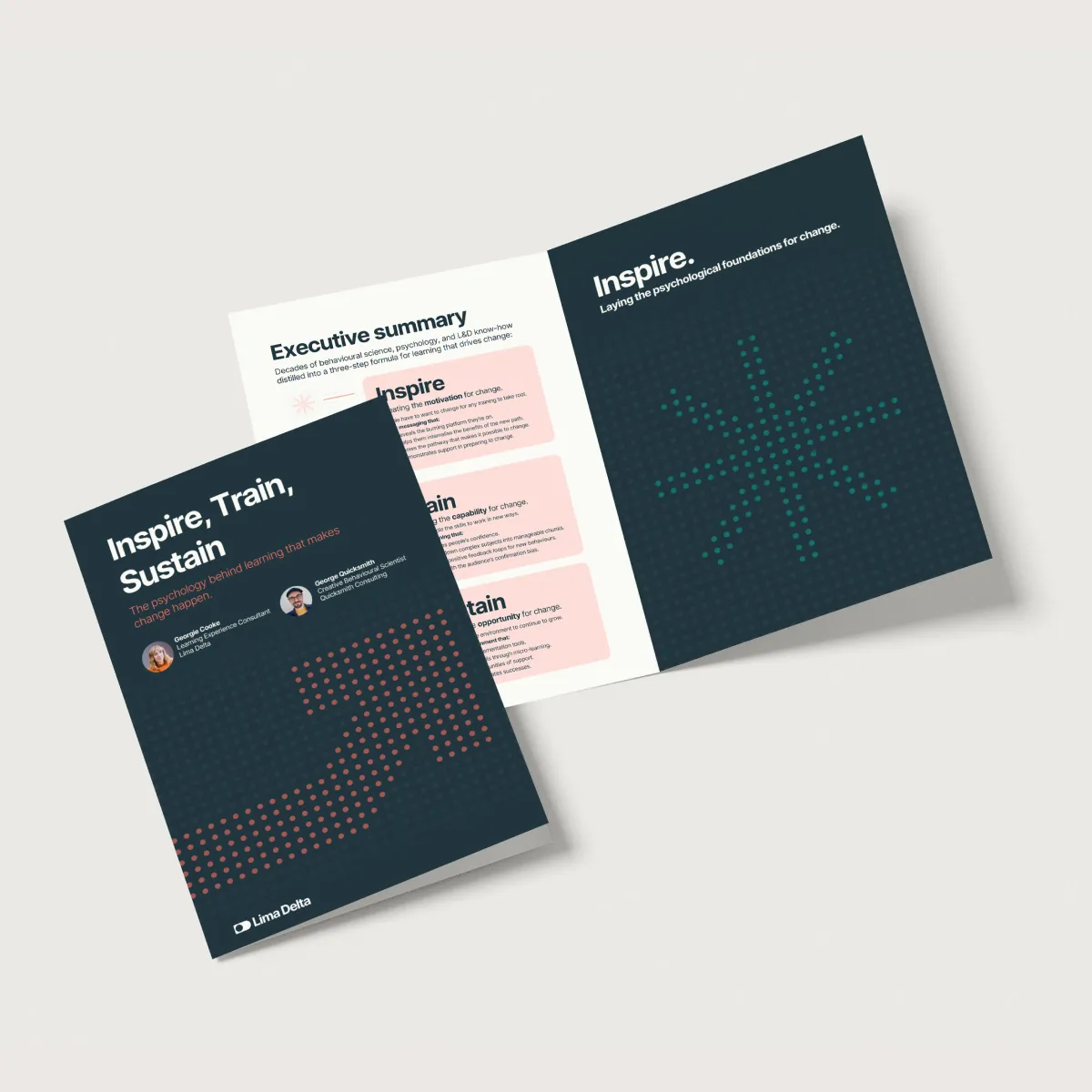
This line of thinking is the bet behind our Inspire, Train, Sustain approach.
If you want to find out more about it, click below.